The Oak Island Mystery
Jean Le Vasseur and the Buccaneer Communal Bank
|
Jean Le Vasseur
Officials in the French West Indies were no less keen than their English counterparts to employ the buccaneers as privateers in time of war. One far-thinking governor of St. Kitts, Monsieur de Poincy, decided to resolve two problems in one. The island of Tortuga, which was populated by buccaneers of several nationalities, was well-placed for attacks on Spanish possessions, if this became necessary, and for assembling forces for maritime raids elsewhere. De Poincy decided to consolidate his hold over the island and annexe it for France. However, De Poincy needed a disciplined force capable of taking and holding the island. Fortunately, such a force was at his disposal - and he was keen to get rid of it. A group of some eighty to one hundred Huguenots, all experienced soldiers or buccaneers, had collected on St. Kitts. Some of these had accompanied d'Esnambuc on earlier raids in the Caribbean, and others were veterans of the Siege of La Rochelle who had found refuge on the island after 1629. Their leader was an experienced soldier, Jean Le Vasseur, who had previously served with d'Esnambuc and now commanded a remnant of the followers of a prominent and militant Huguenot, the Sieur de Soubise. The presence of this band in St. Kitts resulted in some friction with Roman Catholic elements. De Poincy found it expedient to send this well-led and experienced fighting force to Tortuga with instructions to establish French control and hold the island against all-comers. Le Vasseur was an accomplished military engineer. He soon took control of Tortuga and built a fortress, La Roche, overlooking the harbour at Basse Terre. He did not build this on his own and the common buccaneer would presumably lack the necessary technical skills, so he was most likely assisted by his Huguenot followers. They are also said to have blasted tunnels in the rock both on the island and across the channel on mainland Haiti. The fortress was well-situated, well-provisioned, well-manned and held off a succession of Spanish attacks from sea and land. It was built on a rock platform, with a terrace around it, at the foot of which was a fresh-water stream. The rock rose 30 feet all round and the fortress was reached by steps and an iron ladder. Cannon were set in place and a magazine constructed for the defence of the harbour below. Inside, there was a prison named Purgatory and an instrument of torture called Hell. |
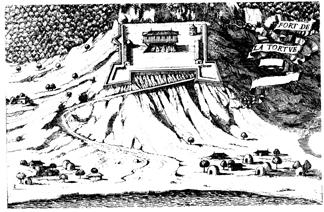
The fort at Tortuga from Du Tertre's 'Histoire Générale des Antilles...' |
|
Le Vasseur treated Tortuga as his own, and distanced himself from de Poincy. The island was popular with the buccaneers - because it was so secure and had an element of autonomy. However, this new-found haven had its disadvantages. Le Vasseur had the audacity to levy taxes on boucan, the meat prepared and traded by the buccaneers, and appropriated a large portion of any booty brought to the island. Contemporary accounts report that, "he made himself rich in short time." His contempt for Catholicism is well documented, though much of the information on Le Vasseur comes from Roman Catholic sources. He refused to allow Catholics to worship. When a large silver cross was captured and requested by the Catholics, he sent them a wooden one instead. His intolerance created much resentment, and trouble soon arose between the Catholics and Huguenots on the island. It has been suggested that Le Vasseur wished to make Tortuga a Huguenot republic. The French governor of St. Kitts was preparing to assault Tortuga and depose Le Vasseur when the pirate king was murdered by one of his lieutenants, in 1653, reputedly over a woman (une garce). The culprits, named Tibaut and Martin, had been adopted by Le Vasseur and nominated his sole beneficiaries. They surrendered the garrison on condition that they could retain the wealth they had acquired from Le Vasseur's estate and not be brought to account for his murder. Le Vasseur's administration of Tortuga is significant. In Sir Henry Morgan's time the booty from buccaneer raids ended up in Jamaica, likewise, in the hands of the administration and the merchants. However, the circumstances at Tortuga were different. Tortuga was an offshoot of St. Kitts and any booty should have been redirected there. However, Le Vasseur kept the majority of the loot to himself, which did not please the governor of St. Kitts. Le Vasseur would have had the problem of securing his ill-gotten gains. In Jamaica, buccaneering was still big business, and operated quite legitimately. The funds were not in dispute and quite openly exchanged. The traders and planters of Port Royal had no need to dig holes in which to secure their money. Le Vasseur would have had little alternative. If ever there was a man among the buccaneers capable of undertaking the Oak Island excavations, with a vast treasure to secure, and with a motive to do so, it was Jean Le Vasseur. |
|
Two in One Consider that for fourteen years (1639 - 1653) the greater part of the plunder from the Spanish Main passed into Le Vasseur's domain. He and the many others in his clique had the wealth and the skills to undertake an operation such as that of Oak Island. With little difficulty, they can be associated with Nova Scotia, despite its being 1,500 miles away. They were French, albeit Huguenots, and Acadia was in French hands during this time. They also had a good motive in wishing to safeguard their accumulated booty. The treasure may have been a personal fortune or one dedicated to a cause. Freedom of worship and freedom from oppression were luxuries the Huguenots had rarely experienced in their native land. Reports of when Le Vasseur's appeared in St. Kitts vary. Some say the date was 1636, which would leave a gap of some seven years from the fall of La Rochelle. One may speculate whether he was in Nova Scotia during that time. The date of his arrival at St. Kitts would have coincided with Richelieu's edict prohibiting Huguenot settlement in New France, and the increasing influence of the Jesuits (the Inquisition). If the work was undertaken about 1650 then, in all probability, it was after Charnisay's death. There would have been little opportunity during the Acadian civil war. Charnisay occupied La Have and is unlikely to have tolerated the presence of a large Huguenot force in the area. Immediately after Charnisay's death, La Tour was in France but would eventually have known about any such project if undertaken on Oak Island. He is more likely than Charnisay to have tolerated it. The use of an English unit of measure could be explained. Le Vasseur may have had an English accomplice similarly versed in engineering. He may have visited England or trained there. However, there are a number of factors acting against this proposition and the chronology is very tight. Charnisay died in 1650. Le Vasseur died in 1653. However, this combination of factors would provide an appropriate setting. The thread that links Nova Scotia to the West Indies and the buccaneers, provides the skills and the labour force, a treasure and a motive, would be the Huguenots. This could be taken further, because one of the most prominent figures in the mystery was also a Huguenot - Joseph Frederick Wallet Des Barres, military engineer, hydrographer and author of The Atlantic Neptune from which the Westhaver map was drawn. The period provides another possibility with the same accumulated treasure. In 1654 the Spanish successfully attacked Tortuga and temporarily dispersed the buccaneers. The following year English forces occupied Jamaica while colonial forces took Nova Scotia. For a time, the buccaneers found safety and a base of operations in Port Royal. Threats to the wealth accumulated by Le Vasseur, or knowledge of its whereabouts, may have influenced a project to remove it to a place of safety. In this setting, it can hardly be claimed that pirates had no treasure, no motive and no skills to accomplish the Oak Island project. Furthermore, it would hardly be surprising were such a project responsible for the legend of the buccaneer communal bank. |
|
© G.J. Bath Source: Bath G.J. Maps, Mystery and Interpretation Vol 2. Oak Island Speculation, KeyPress 2013. |
| Home |